- …
- …
Intelligent Patient Management (IPM)
Designed for Veteran Care, Senior Living
& Rural Health Success
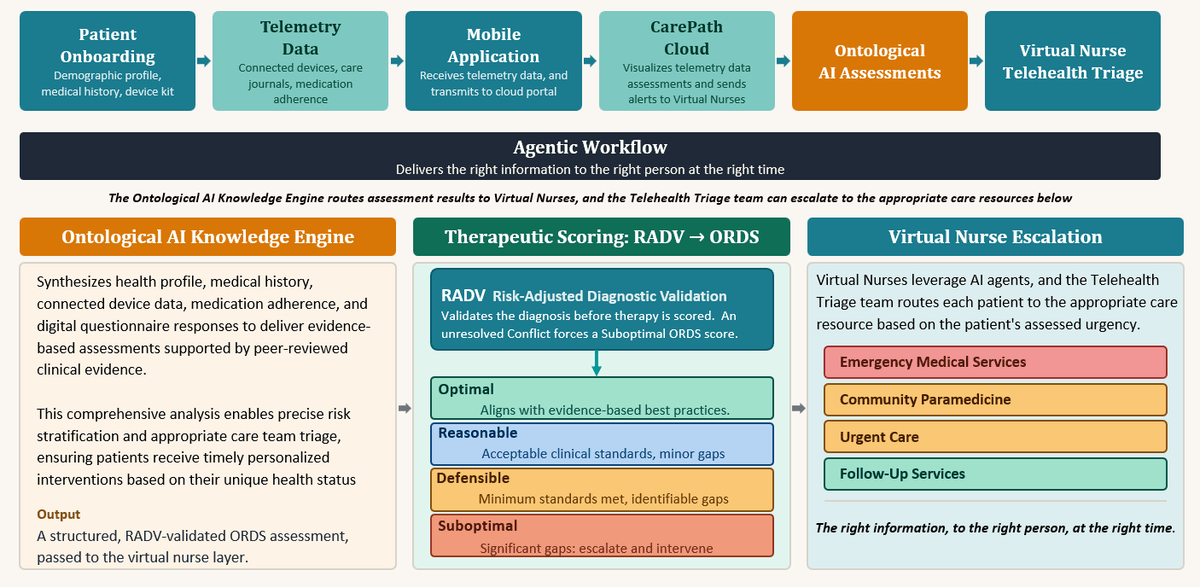
Ontological AI that reasons clinically
Distributed Care that acts locally
Health Systems Safety that protects by design
Distributed Care - Agentic Workflow
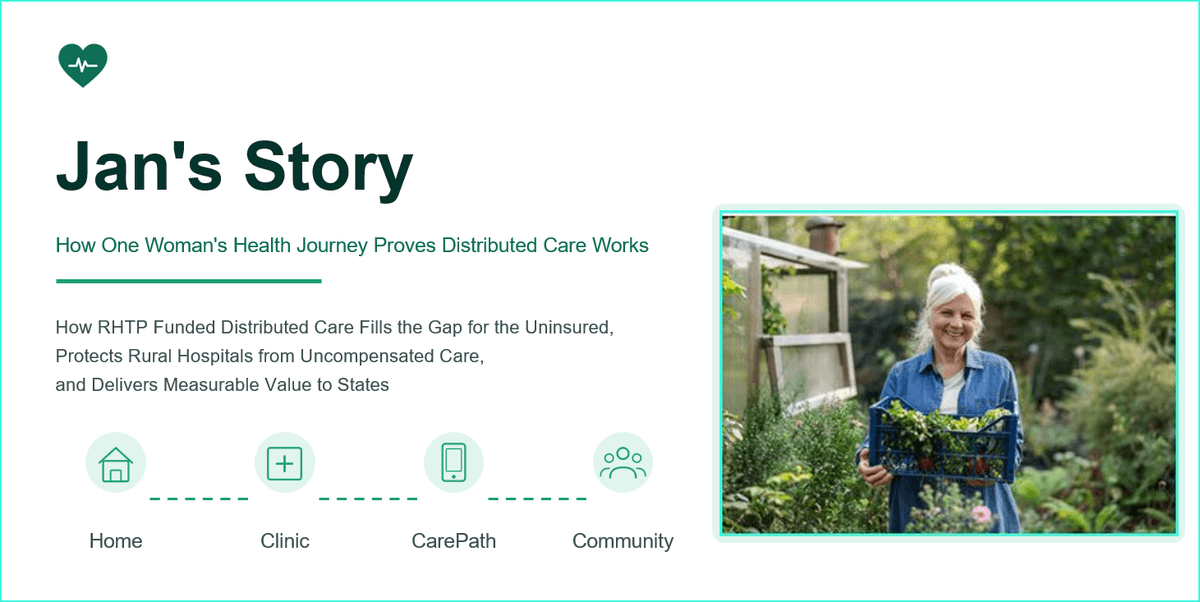
Janis is 63 years old. She lives alone on a small property in a rural community and tends a vegetable garden each summer. She isn't particularly computer-savvy and has never used a federal eligibility portal.
For most of her adult life, healthcare was something Jan delayed or avoided. She worked steadily, cared for family members when needed, and learned to be careful with money and expectations. In her late fifties, Medicaid finally provided something she hadn't had before: continuity. Blood pressure medication she could refill without fear of cost, an annual visit with a primary care provider who knew her history, and the assurance that when something felt wrong, she could call without wondering whether the call itself would become a financial problem.
Jan relies entirely on Medicaid for her healthcare, her blood pressure medication, her annual wellness visit, and the occasional trip to see her PCP when something feels wrong. Her fixed income, which includes Social Security and modest retirement savings, places her at 138% of the federal poverty level, squarely in the gap left by the erosion of enhanced premium tax credits.She has managed until recently without much help and without much room for error. She has done everything right. The Medicare coverage she has been waiting for her entire adult life to reach is two years away. Two years is a long time to hold your breath.
Security
Your Patients' Data Is Safe. That's Not a Promise; It's Architecture.
Security isn't a feature we added to the RHT platform. It's the foundation everything else is built on. From Azure-powered, private-labeled portals to private APIs, every access point is protected by authentication and encryption. All data transmission occurs over SSL/HTTPS, and protected health information (PHI) is encrypted both at rest and in transit.
RHT Solutions meets or exceeds all HIPAA and HITECH Act requirements, not just for data we hold, but for every transmission to or from the CarePath platform.
Why Microsoft Azure?
We chose Azure because it is purpose-built for healthcare. Azure Health Data Services supports open interoperability standards including FHIR® and DICOM®, enabling secure, unified data exchange across care settings. Azure holds HITRUST CSF certification and aligns with NIST SP 800-53, FedRAMP High, ISO/IEC 27001, and SOC 2, the same compliance frameworks that federal and state health programs require.
Access to sensitive data is governed by Role-Based Access Controls (RBAC), so only authorized personnel can access what they need; nothing more. Azure Key Vault manages encryption keys. Azure Firewall, Web Application Firewall (WAF), and Network Security Groups reduce attack surface and guard against threats including DDoS. Activity monitoring and threat detection tools enable rapid identification and response when anything looks unusual.
When AI and analytics tools are used within the platform, they operate inside the same compliance boundary established by our Microsoft BAA, meaning PHI used to generate clinical insights never leaves the protected environment.
Microsoft builds and operates its cloud infrastructure under the Microsoft Security Development Lifecycle (SDL) and Operational Security Assurance (OSA) frameworks, requiring rigorous validation of source code, configurations, and dependencies at every stage. When you deploy on Azure, you inherit that discipline.
The result: A platform your compliance team can approve, your clinical team can trust, and your patients never have to worry about.